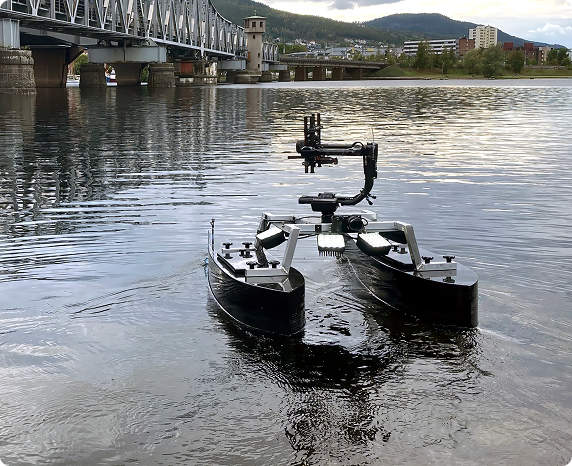
A highly capable waterborne platform designed for precision inspections and data collection in aquatic environments. This advanced USV operates seamlessly on water, equipped with state-of-the-art sensors and cameras for high-resolution mapping, surveying, and environmental monitoring. With its rugged build and autonomous capabilities, the NAS USV excels in challenging conditions, delivering reliable performance for missions such as infrastructure inspections, maritime operations, and environmental assessments. Whether deployed independently or in combination with aerial and ground systems, the NAS USV ensures comprehensive, accurate data for critical tasks.
NAS Unmanned Ground Vehicle (UGV)
A versatile and rugged robotic platform designed for complex ground inspections in challenging environments. The NASUGV is equipped with advanced sensor systems and cameras, allowing it to capture high-resolution data in confined or hard-to-reach areas, such as parking structures and industrial sites. With its robust design and high mobility, the NAS UGV is capable of operating in a variety of terrains and weather conditions, making it ideal for detailed infrastructure inspections, surveying, and data collection. Whether working independently or in coordination with aerial and marine unmanned systems, the NAS UGV ensures precise and reliable performance for mission-critical operations.
Technology:
HausBots HB2 Crawler
The HausBots HB2 is purpose-built for non-destructive testing (NDT) and high-definition visual inspection across a wide range of asset materials, including stainless steel, non-ferrous surfaces, and concrete structures. Utilizing a temporary vacuum-suction adhesion system combined with high-grip caterpillar tracks, the crawler can securely traverse horizontal, vertical, and inverted surfaces. Remotely operated by trained professionals, the system enables safe access to hazardous or restricted areas. Integrated HD cameras and advanced sensor payloads capture high-resolution imagery and video for accurate identification of cracks, fatigue, pitting, and surface degradation.
Operational Benefits
Removes personnel from high-risk inspection activities traditionally involving scaffolding, rope access, or abseiling. Robotic deployment delivers faster and more consistent inspections, reduces asset downtime, and significantly lowers manpower requirements—often requiring only a single controller on site. Live video transmission provides real-time visibility, enabling immediate assessment and informed decision-making without physical entry into the asset.
Specialized Industry Applications
While primarily deployed across Oil & Gas, Infrastructure, and Manufacturing, sectors we also maintain a strong focus on the Dairy, Food, and Pharmaceutical sectors. Our inspections support clients’ Asset Condition Assessment Processes (ACAP) by providing reliable data for annual risk evaluation and defect management. We are highly effective in assessing thin-wall stainless steel assets such as milk silos and dryer chambers, as well as concrete structures. Our expertise includes targeted defect mapping in high-stress areas—particularly hammer impact zones and structural connections. Early detection of pitting and cracking also eliminates potential microbial “seeding points,” supporting stringent hygiene and product safety requirements.
Defect Detection Capabilities
Crawler inspections support early identification of common structural and surface defects, including:
Centreline Cracks
Centreline cracking often results from incorrect repair procedures or unresolved root causes. Early detection allows engineering assessment before crack propagation compromises structural integrity.
Pitting
Pitting can occur when water residue remains on stainless steel surfaces long enough for the passive oxide layer to degrade, particularly after CIP processes. Early detection enables corrective actions such as polishing, pickling, and re-passivation before replacement becomes necessary.
Poor Weld Penetration
Insufficient weld penetration leads to stress concentration and reduced weld strength, even when ground flush. Crawler inspections allow close-range assessment of weld quality.
Weld Splatter
Weld splatter is typically the result of poor welding practices and presents a hygiene and integrity concern. Identified areas can be rectified through grinding, pickling, and re-passivation.
Talk to Skadi Offshore
To discuss crawler-based inspection services or assess suitability for your assets, contact Skadi Offshore to review inspection objectives and deployment options.